The Diffraction limit describes the maximum possible MTF / resolution that a “perfect” lens could possibly have
Archives
dispersion
(from latin dispergere, “to scatter”, to disperse” ) :
Dependency of a measure on frequency / wavelength.
 (C) Wikipedia, zum Animieren bitte klicken
Using a Prism dispersion leads to splitting of white light beam into individual colors. A rainbow where light takes different paths inside the water dropplets, depending on their wavelength is another “real world” example of dispersion.
Every optical medium / glass type has different refraction indices for the various wavelength of light. The number that describes how different the light paths of the various wavelengths are, is the Abbe-number.
UNder dispersion formulas you find the most common formulas
Dispersion Formulas
Each optical material (glasses, plastics, gases) have a different refraction index for each wavelength.
Instead of keeping long tables, it’s possible to describe the behaviour of optical materials by formulas.
here are the main formulas used :
1: Sellmeier (preferred)

2: Sellmeier-2

3: Polynomial

4: RefractiveIndex.info

5: Cauchy

6: Gases

7: Herzberger

8: Retro

9: Exotic

Distortion
see
Optical Distortion
TV Distortion
Optical Distortion vs. TV Distortion
Barrel Distortion
Pincushion Distortion
DOF
Effective Focal Length
(=EFL)
Distance between the principal point P2 and the focal point F2.
Don’t confuse with the back focal length (Back Focal Length BFL)!
EFL
electronic magnification
describes, how much larger an image sensor is displayed on a monitor.

May the diagonal of the sensor be 6mm (third inch) and the monitor diagonal be 50″ = 128cm = 1280mm

see also:
optical magnification
monitor magnification
entocentric
When using entocentric lenses, objects at larger distances appear smaller, closer object appear larger.
The most common entocentric lens is in our eyes.
see “comparison: entocentric – telecentric – pericentric”
entrance pupil
= image of the physical aperture of the lens , as mapped by the lens elements between aperture and object. For front-aperture-lenses, entrance pupil and front aperture are identical.
This is the apparent opening that we see as humans when we look towards lens from the object side.
![800px-Apertures[1]](https://www.optowiki.info/wp-content/uploads/2014/09/800px-Apertures1.jpg)
What we see here is _not_ the mechanical iris, but just an image of the iris as seen through the lenses in front of the mechanical iris. You can imagine the lenses in front of the iris as kind of a magnification glass, through which we see the mechanical iris.
Diameter and position of the entrance pupil influence the F-number and thus the light sensitivity of a lens and also the angle of view.
The diameter of the entrance pupil alone does _not_ describe the F-number (=measure for the ability to collect light)! Only comparison lenses of the _same_ focal length allow to directly decide which Lens has the lower F-number
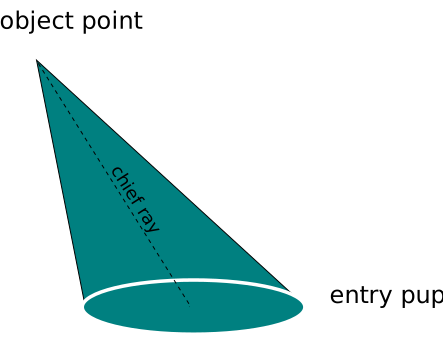
Light of _each_ object point in the field of view of the lens reaches _each_ point on the front lens of the objective, but only the light directed to the entrance pupil of the lens reaches the matching image point.
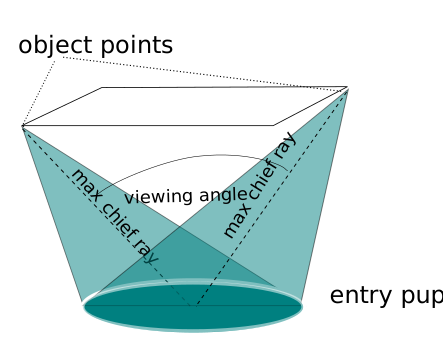
Rays from the object point directed to the center of the entrance pupil are called “chief ray”.
The (object side) chief ray angle is the angle between optical axis of the lens and all chief rays. The viewing angle of the lens is twice max chief ray angle.
Here a 3D Graphics that shows in yellow the light from the Objetpoint that heads the entrance pupil and on its way hit’s the front lens of the system. Move the green point.