= Full Width at Half Maximum (German : Halbwertsbreite)
![1200px-Halbwertsbreite.svg[1]](https://www.optowiki.info/wp-content/uploads/2018/01/1200px-Halbwertsbreite.svg1_.png)
= Full Width at Half Maximum (German : Halbwertsbreite)
is another term for paraxial optics.
Carl Friedrich Gauss (1755-1855) laid in 1840 the foundations for this subject. In his work “Dioptrische Untersuchungen” Gauss showed, that the behaviour of any lens system can be determinedform the knowledge of it’s six cardinal points (also called Gauss-Points), namely two focal points, two nodal points (of unit angular magnification) and two principal points (of unit linear magnification) .
Included in the paper were recipes for experimentally determining the positions of these points and iterative methods for calculating them in terms of the surface curvatures, separations and refractive indices of the lens system.
He explicitely mentioned two equations where ray height r and ray angle  of an input and output ray are linked, as used in the the ABCD-Matrix.
![\[r' = A r + B \theta \]](https://www.optowiki.info/wp-content/ql-cache/quicklatex.com-eee94eb33e2212de9dfa59cbbb75c24a_l3.png "Rendered by QuickLaTeX.com")
![\[\theta' = C r + D \theta \]](https://www.optowiki.info/wp-content/ql-cache/quicklatex.com-b7c72612d7f48d118e4739d09d192c63_l3.png "Rendered by QuickLaTeX.com")

![\[ \left( \begin{array}{c}r'\\\theta'\end{array} \right) = \begin{pmatrix} A & B \\ C & D \end{pmatrix} \left( \begin{array}{c}r\\\theta\end{array} \right) \]](https://www.optowiki.info/wp-content/ql-cache/quicklatex.com-e7068e9e82504319d431076f2eb5b562_l3.png "Rendered by QuickLaTeX.com")
But Matrix notation wasn’t known at that time. So instead he used an algorithm he learnt from Leonard Euler. It was a shorthand form of continuous fraction, now known as Gaussian Brackets.
It’s only allowed to use ABCD Matrices in the paraxial range, with 
The angles and  are measured in radians!
For a table of ray transfer matrixes for simple optical components see ABCD matrix

| Type : gnomonical | weak | medium | strong | max |
|---|---|---|---|---|
| angles | 54° | 75° | 102° | < 180° |
see:
fisheye types
see “comparison: entocentric – telecentric – pericentric”
 to infinity
There are two Formulas in use:
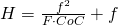

This is the formula we use here. The results just differ in the focal length of the lens.
and


Where CoC is the circle of confusion, F is the F-number and f is the focal length of the lens.
The hyperfocal distance has curious mathematical properties:
The hyperfocal distance H is the distance at which you have to focus an object to receive the largest depth of field. If, namely, a lens is focussed to H, it is focused from to infinity.
, so everything from  to
to  focused., so everything from
  to focused., so everything from
  to focused.
 , so everything from
  to
to  focused.
The distance

is the Depth of field.
Notice:
Although monitors and paper photos are rectangular, lenses are (usually) round.
So why are the images generated by round lenses not round? Well .. images of lenses ARE round.
The diameter of these rounds images is called image or image circle. Outside the image circle the picture (hopefully) is dark. If the image circle is smaller than the diagonal of the sensor, the image has dark corners.
When the Image Circle is smaller than the height of the sensor, the image is round and outside of the image circle it’s dark.
Images of Fisheye lenses are typically like that and are then called “circular fisheye image”. Such image are especially helpful for checking whether the axis of sensor and lens are aligned:
The image circle must be in the middle of the (rectangular) screen image.
Maximum (diameter of the) circle that receives (good quality) image information.
The image circle limits the maximum sensor size for which a lens can be used.
An image circle of 6mm limits the use to maximum sensor to 1/3″.
An image circle of 8mm limits the use to maximum sensor to 1/2″.
An image circle of 16mm limits the use to maximum sensor to 1″.
Distance between the image side principal plane and the image (measured on the optical axis).
When lenses are designed, one of the important parameters is the spectrum for which the lenses are to be used.
Most lenses on the market are “corrected” (read : “designed”) for the visible range of the light, the part that humans can see. These are wavelengths between about 420nm and 720nm, deep violett to deep red colors.
Lenses are called IR corrected, if they are designed for near Infrared light (NIR .. roughly 800 to 1100nm), so you _could_ use them if your Illumination contains these wavelengths.
If lenses are not IR corrected, they will typically have a so called Focus Shift (or “longitudinal color aberration”) , say the focal length of an IR image is different from the focal length of the color image, thus either the color image or the IR image is focussed, but in general not both.
Lenses that _are_ IR corrected usually have a special antireflection coating , suited for the infrared spectrum.
One thing you have to take into account however is the quantumefficiency of your sensor, say, how well it can receive NIR light. Often sensor can receive light in this range of wavelengths one one third as good as they do for the visible range, say the brightness of the image is just 1/3 .. and lower. Ask your supplier about sensors dedicated for IR light.
If a lens is designed for VIS (= visible light) and also for NIR, you have to keep in mind that you in general can NOT get a nice color image _and_ a nice NIR image at the same time.
This is because color pixels let various NIR wavelengths pass say, the nice color images are overlayed with IR light.
According to the Rayleigh criterionlight of, say, 850nm wavelength can achieve only half the resolution of a lens optized for half the wavelength (425nm)
This means, even a cristal clear color image is overlayed by a slightly blurred IR image.
Say, if you _can_ choose, go for Visible light, not for NIR light.
If you need IR light AND Visible light at the same time, for example door cameras have this challenge, then go for a special filter that lets VIS pass plus a small IR range, for example 940 +/- 20nm
A lens with 10 lens elements accordingly generates sequences
T0->T1->T2->… -> T10
and
B0->B1->B2->….-> B10
The “Gauss lens equation,” as it is known, goes like this:

where
f = focal length,
g = distance to object (measured from object side principal plane H).
b = distance to image (measured from image side principal plane H’).
It can be solved for focal length, object distance and image distance.

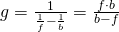
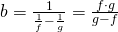
What can be derived from this formula?

And therefore 

(but subtract the distance of the principal points from X)
 .
. holds: the image is generated on the object side (!) of the lens.
 holds. Most calculators don’t care (including ours), As a result, anytime larger viewing angles are involved, the results are essentially a “informed guess.”
![Lens_and_wavefronts[1]](https://www.optowiki.info/wp-content/uploads/2013/06/Lens_and_wavefronts1.gif)