Archives

A B C D E F G H I L M N O P R S T V W

pericentric

= hypercentric

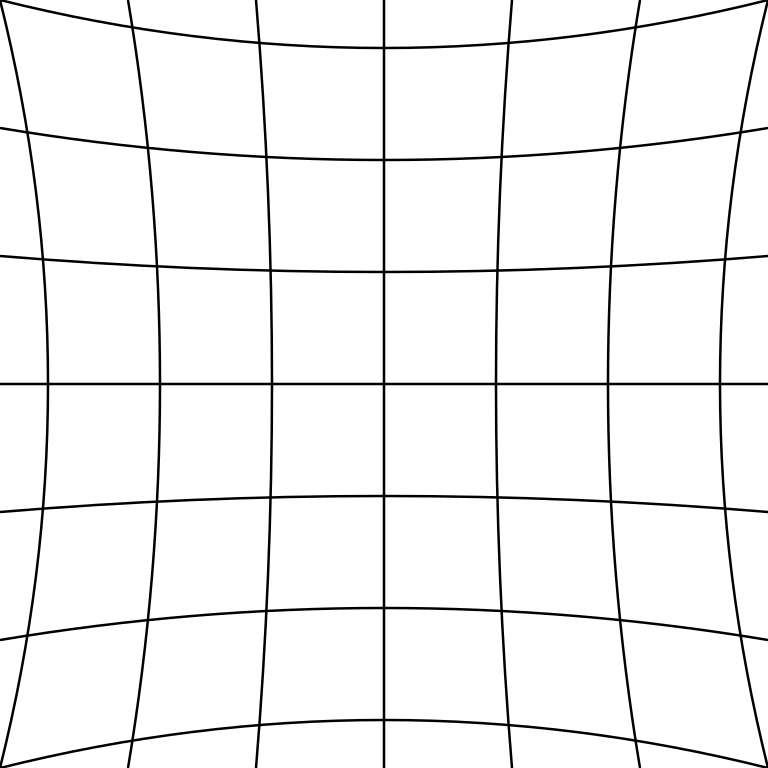
With pericentric lenses objects at larger distances appear larger(!) and objects at closer distances appear smaller.

Perizentric lenses allow for example to view a can from top and the sides at the same time.

This reverses our normal viewing experience.

Pericentric lenses got to be MUCH larger than the object under inspection.

see “comparison: entocentrictelecentric – pericentric”

Application : A cylinder with a drilling that is centered on one circular side and decentered on the opposite side is to be inspected for foreign parts in the drilling.
The rotation of the cylinder is not known, so we would need a lens that can look from all sides “outside-in” at the correct angle.
Solution: DIY with the help of a Fresnel Lens, a normal M12 lens and the graphic calculator below …

pixel vignetting

A kind of vignetting which occurs exclusively with digital cameras.

Possible causes are:

  • the pixels are not completely flat due to construction on the sensor surface, but in small cavities. Too shallow light cast shadows on the edges of the pixels, like the evening sun at some point no longer reaches mountain valleys.
  • The sensor uses micro-lenses (small converging lenses) to capture as much light as possible for each pixel. From a certain off axis angle lenses are no longer capable to deflect the light strong enough and the light can’t reach the pixel no more.
  • With image side telecentric lenses such vignetting does not occur because the incident light rays are parallel to the optical axis.
    The latest sensor technologies however try to correct the Pixelvignettierung on-chip (= directly in the sensor) or by micro lenses that have differently shape in the corners than in the center.
    Thus it may happen that the image side telecentric lenses surprisingly show vignetting.

principal plane

Each (rotation symmetric) lens has two principal planes. These (hypothetical) planes are perpendicular to the optical axis and are the planes on which light beams parallel to the axis coming from infinity seem to bend (and then go through the respective focal points).

The image side primary plane is formed where a light ray parallel to the optical axis enters the first lens of a lens system and intersects with the corresponding ray leaving the last lens element.

The object side primary plane is formed where a light ray parallel to the optical axis enters the last lens of a lens system and intersects with the corresponding ray leaving the first lens element.

NOTE:
This only applies to the paraxial optics, i.e. very close to the optical axis.
For rays more distant to the optical axis spherical aberration distorts this behaviour.
In a single thin lens the two principal planes merge and can be approximated by the center of the lens.

Rayleigh Criterion

The diameter of the smallest disk that a lens can produce as image of a point size object is called Airy-disk

According to the so called “Rayleigh Criterion” holds:

The smallest possible Airy-Disk that a (diffraction limited) lens can generate is

D = 2 * 1.22 * Wavelength * F\#

The best possible resolution on image side (at 20% contrast) is the radius of this smallest possible Airy-Disk

R = 1.22 * Wavelength * F\#

When you double the F#, you lose factor 2 of resolution in each x and y direction.
If the lens supported 5 Megapixel before, then it supports only 1.3 Megapixel after
When you double the wavelength (for example 850nm IR instead of 420nm blue), you lose factor 2 of resolution in each x and y direction. If the lens supported 5 Megapixel before, then it supports only 1.3 Megapixel after

See F-number

refractive index

refractive index = \frac{speed\ of\ light\ in\ vacuum}{speed\ of\ light\ in\ the\ current\ medium\ (eg.\ glass)} =: \frac{c}{v}

With c = 2.99792458 \cdot 10^8  \frac{m}{s} , roughly 300000km per second

In other media than vacuum the light is slower. Therefore, the smallest refraction index is 1.
The speed of light in the medium is v = \frac{c}{v}.
Therefore the speed of light in a medium is factor “refractive Index” slower than the speed of light c in vacuum.
Glass slows down light of different wavelengths (“colors”) by different factors.
Results are different refractive indices, “depending on the color (wavelength) of light .”
The higher the refraction index, the stronger the change of direction at the boundary between different media
As media have different refraction index for blue, green red light, red/green/blue light takes a different path through a lens!

[table]Medium,typical refractive index
Vacuum,1
Air,1.000293
Helium,1.000036
Hydrogen,1.000132
Carbon dioxide,1.00045
Water at 20 °C,1.333
Ethanol at 20 °C,1.36
Olive oil at 20 °C,1.47
Ice,1.31
PMMA (= acrylic = plexiglas),1.49
Window glass,1.52
Polycarbonate (Lexan™),1.58
Flint glass (typical),1.62
Sapphire,1.77
Cubic zirconia,2.15
Diamond,2.42
Moissanite,2.65, -[/table]

After a reflection light propagates from right to left, and it’s velocity can be regarded as negative. Using velocity instead of speed in the above equation, the index of refraction can also be regarded as negative.

S-Mount

(= Short Mount) 
 is a lens mount for use of mini-lenses with M12x0.5 thread (diameter = 12mm, 1 revolution = 0.5mm stroke. 


S-mount lenses are either used in special holders, or with adapters or in C-mount CS-mount cameras.

Note:
Like with C-mount, CS-mount and F-mount lenses diameter and thread pitch are fixed.
But different from these the back flange length (distance from the mechanical stop of the lens to the sensor) is NOT standardized.
This can lead to mechanical problems with filters mounted between the lens and sensor.



