Archives

A B C D E F G H I L M N O P R S T V W

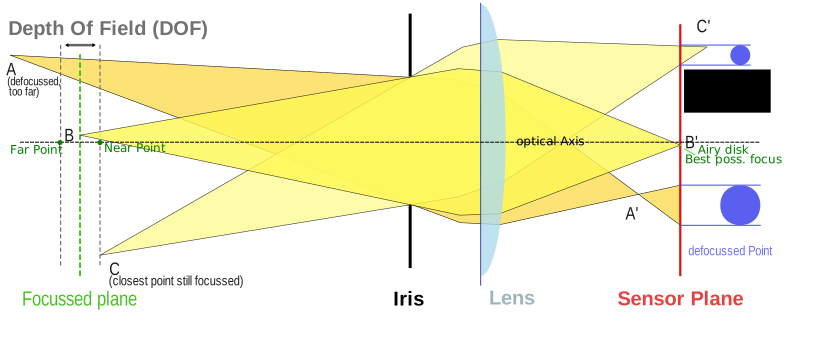
near point

closest point on optical axis with an image that has „acceptable sharpness“

NearPoint = \frac{(FocalLength^2 \cdot ObjectDistance)}{(FocalLength^2 + F\# \cdot CoC \cdot (ObjectDistance - FocalLength))}

Where CoC is the Circle of Confusion (the largest accepted Airy-disk) in Millimeter.

Alternatively, we can express the NearPoint using the magnification M :

NearPoint = \frac{(FocalLength^2 \cdot (M + 1))}{(FocalLength \cdot M + F\# \cdot CoC )}

If we use for example a 1/2.5″ 5 Aptina Megapixel greyscale Sensor mit 2.2\mu pixel pitch, we can use the pixel diagonal as CoC for crisp images, say CoC = 2.2\mu \cdot \sqrt{2} = 3.1 \mu = 0.0031mm

A 5 Mega lens with f=7.2mm focal length and F-stop F2.4, focused to an object distance of 100mm then has a far point of

FarPoint = \frac{((7.2mm)^2 \cdot 100mm)}{((7.2mm)^2 - 2.4 \cdot 0.0031mm \cdot (100mm-7.2mm))} = 101.35mm
und einen Nahpunkt von
NearPoint = \frac{((7.2mm)^2 \cdot 100mm)}{((7.2mm)^2 + 2.4 \cdot 0.0031mm \cdot (100mm-7.2mm))} = 98.69mm
and thus DOF = FarPoint - NearPoint = 2.66mm
If instead we use a 5 Megapixel greyscale Sony Sensor with 3.45\mu pixel pitch, we can choose as CoC the diagonal of the pixel for crisp images, say CoC = 3.45 \cdot \sqrt{2} = 4.86 \mu = 0.00486mm

A 5 Mega lens with f=7.2mm focal length and F-stop F2.4, focussed to 100mm then results in

FarPoint = \frac{((7.2mm)^2 \cdot 100mm)}{((7.2mm)^2 - 2.4 \cdot 0.00486mm \cdot (100mm-7.2mm))} = 102.13mm
and a nearpoint of
NearPoint = \frac{((7.2mm)^2 \cdot 100mm)}{((7.2mm)^2 + 2.4 \cdot 0.00486 \cdot (100-7.2))} = 97.95
thus we get DOF = FarPoint - NearPoint = 4.18mm
If we use a color sensor instead we can use CoC=2 \cdot PixelSize for crisp images. For the two sensors above we then get:


DOF_{5 Mega Aptina} = 101.93mm - 98.14mm = 3.78mm
DOF_{5 Mega Sony} = 103.06mm - 97.11mm = 5.93mm
To increase the DOF we can increase the Pixel Size, but we either lose resolution, or (at the same pixel count) the magnification changes)
If you change the focal length of a lens in a way, that (with the same sensor) you get the same FOV (then from a different distance) this results in the same DOF !!!
see also https://www.optowiki.info/blog/can-i-increase-the-dof-by-changing-the-focal-length/
To increase the DOF we can keep the working distance and the pixel size while reducing the sensor size, but then we lose resolution (because less of the same size pixels fit on the now smaller sensor)
When a lens is focussed to the hyperfocal distance H, the far point is at \infty and the near point is at \frac{H}{2}.
The DOF is \infty then, thus focussing to the hyperfocal distance results in the largest possible DOF.

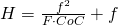
Yet another way to express the Near-Point is to use the Hyperfocal distance H :
H = \frac{f^2}{F \cdot CoC} + f

If the lens is then focused to some object distance OD, this OD can be expressed as fraction of H :

OD = \frac{H}{x}

or

x = \frac{H}{OD}

Then the near point is
NearPoint = \frac{H}{x+1},

the far point is
FarPoint = \frac{H}{x-1}

and the Depth of field is
DOF = FarPoint - NearPoint = \frac{H}{x-1} - \frac{H}{x+1}

When we set the object distance OD to the hyperfocal distance H, we get:
OD = H
Therefore from
x = \frac{H}{OD}
we get
x = 1.
This means however, that
FarPoint = \frac{H}{x-1} = \infty
and therefore,
DOF = FarPoint - NearPoint = \infty - H/2 = \infty
For a lens with f=12mm, F#=2.8 and a CoC of 3.1um we get

H = \frac{12^2}{2.8 \cdot 0.0031} + 12 = 16602mm

For OD = 200mm we get
x =  \frac{H}{OD} =   \frac{16602}{200} = 83.01mm
So, with
FarPoint = \frac{H}{x-1} = \frac{16602mm}{83.01mm-1mm} = 202.44
and
NearPoint = \frac{H}{x+1} - \frac{16602mm}{83.01mm+1mm} = 197.62
we get
DOF = FarPoint - NearPoint = 202.44 - 197.62 = 4.82mm

For OD = 100mm we get
x =  \frac{H}{OD} =   \frac{16602}{100} = 166mm
So, with
FarPoint = \frac{H}{x-1} = \frac{16602mm}{166mm-1mm} = 100.62
and
NearPoint = \frac{H}{x+1} - \frac{16602mm}{166mm+1mm} = 99.41
we get
DOF = FarPoint - NearPoint = 100.62 - 99.41 = 1.21mm

Therefore by decreasing the OD by factor 2, the DOF decreased by factor 4.

When the magnification increases by factor 2, the DOF decreases by factor 4

or, equivalent :

When the object distance decreases by factor 2, the DOF decreases by factor 4

normal lens

Entocentric lens with a focal length equal to the sensor diagonal.

For SLR cameras (film 24x36mm, 42mm diagonal) is an f = 42mm a normal lens. Previously f = 50mm lenses are called normal lens (well, f = 50mm was close to f = 42mm)
Third inch lens (6mm sensor diagonal) of f = 6mm focal length are normal lenses.
Half-inch lenses of f = 8mm are normal lenses.
One-inch lenses of f = 16mm are normal lenses.
A third inch lens with f = 6mm lens and a half-inch lens of f = 8mm
 have the same field of view!

Normal lenses help to define “wide angle lens” and “telephoto lenses”: 

Lenses with a focal length less than that of a normal lens is called wide angle lens.
Lenses with a focal length greater than that of a normal lens are called telephoto lens.

However, an f = 8mm lens on a 1/3 sensor is a “(slight”) “tele lens and on a 1” sensor, a wide angle lens.

Numerical Aperture

The Numerical Aperture (“NA”) is a measure for the resolution of a lens.

At given working distance the diffraction limited lens like a telecentric lens with the higher Numerical Aperture has the better resolution

The Numerical Aperture is calculated as sine of half the aperture angle multiplied by the refraction index of the media.

According to Snells Law, the Numerical aperture of the lens stays constant across various media :
NA = n_1 \sin(\theta_1) = n_2 \sin(\theta_2) =...

NA = n \sin(\theta) = n \sin(atan(\frac {EntrancePupilDiameter}{2 FocalLength}))

From the NA , you can calulate the F-Number of a lens from the above equition with n about 1 and because (for small angles sin(x) is about tan(x)) to a simplified:

F\# = \frac{1}{2 NA}

If magnification and pupil magnification P are known, we can calculate the effective F-number :

WorkingF\# = \frac{1}{2 NA_{image}} = (1- \frac{magnification}{P}) F\#

and also

\frac{1}{2 NA_{object}} = (\frac{magnification - P}{magnification P}) F\#

With the object distance increasing to infinity, the Working F# nears the F#.

Object distance

Distance between the object side principal point and the object.
For larger distances, this is about the working distance

Object to image distance

Optical Density

Optical density is a measure used for filters to describe how much light of a blocked wavelength still passes the filter

Abbreviation: ODn

the optical density is given by the formula:
ODn = 10^-n = 1/10^n
OD0 = 10^-0 = 1/10^0 = 1 = 100% light passes
OD1 = 10^-1 = 1/10^1 = 0.1 = 10% light passes
OD2 = 10^-2 = 1/10^2 = 0.01 = 1% light passes
OD3 = 10^-3 = 1/10^3 = 0.001 = 0.1% light passes
OD4 = 10^-4 = 1/10^4 = 0.0001 = 0.01% light passes
The optical density is an input value, demanded by the Application.
OD2 equals 1 percent.
For a camera of 256 intensity levels this equals 2.6 intesity values. This is not much stronger than the sensor noise.

OD3 entspricht 0.1 Prozent.
For a camera of 256 intensity levels this equals 0.26 intesity values. This is less than the sensor noise.

The higher the number the better the blocking.
The higher the number the more expensive the filter.
Typical values for comemrcial filters are OD2,
higher quality filters have OD3
Filters ilters for outdoor use might need OD4 or higher to block too intensive sunlight.
For a + b = c we get ODa + ODb = ODc
so you can generater an OD6 filter by two OD3 filters. However, the optics should be prepared for the thicker glass then.

Optimal Aperture

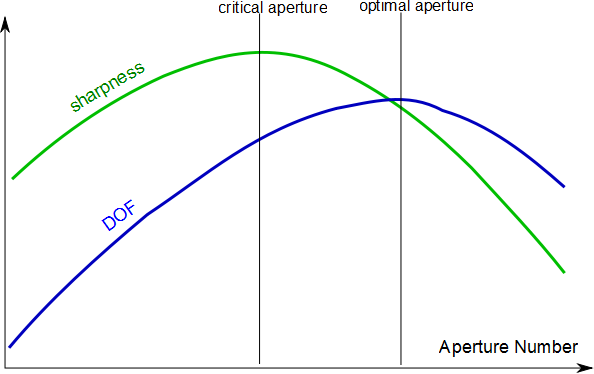
F# with the largest possible DOF.
Larger F# reduces the DOF due to diffraction

critical and optimal aperture

orthographic

orthographic lenses are a type of fisheye lenses

orthographic lenses are also called” hemispherical“or “orthographisch
orthographic lenses use an image mapping function of type
r = f sin \theta

maintains planar illuminance

Type : orthographic weak medium strong max
angles 66° 90° 120° < 180°

hemi180[1]

An orthographic / hemispherical fisheye, uses a parallel projection of a hemisphere onto a plane. The resulting image will obviously be circular. The widest view angle is 180 degrees. At +/-90 degrees extreme distortion will occur. Due to this heavy distortion it’s less often used than f-Theta / angular fisheye.

see:
fisheye types

parfocal

A parfocal lens stays in focus when the magnification / focal length changes.
Some amount of defocussing is inevitable, but the amount is so small that it is considered as insignificant.

In microscopy parfocal lenses stay in focus when the magnification is changed.

The image stays focused when the magnification is changed from 40x to 10x
Most bright field microscoped are parfocal.
In photography, a zoom lens is parfocal, a varifocal lens is not.
Motor-Zoom lenses are actually varifocal. When you change the magnification, also the focus changes. However the focus motor can work in parallel to the focal length motor, so for the user the lens seems to be parfocal.