Standardized interface for the mounting of lenses, described in ISO 10935 (1996-12) Optics and optical instruments – Microscopes – Interface Type CS
The diameter of the thread is 1 “(one inch) and there are 32 threads to 1” in length.
The distance between the mechanical stop of the lens and the sensor in cross bolts in air is 12.52 mm. These are about 5mm less than for C-mount lenses.
C-mount lenses can (with an 5mm extension (C-CS-mount adapter)) be used in CS-mount cameras,
However CS mount lenses can not be used in C-mount cameras.
CS-Mount lenses are mostly used in security systems, often these are wide-angle lenses.
range in working distance for which the image is (acceptably) focused.
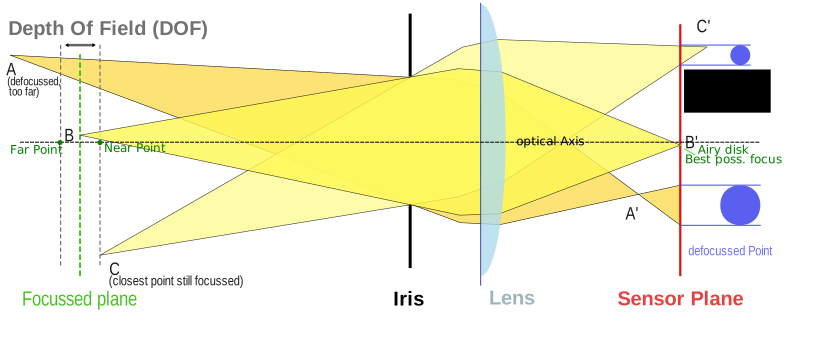
Depth Of Field
DOF = Far Point – Near Point
The largest depth of field (namely infinity) we get when we focus the
lens to the so called
hyperfocal distance. The focus extends from H/2 to infinity.
see also Bokeh
Image side equivalent of the DOF (Depth Of Field), so it is the range of acceptable sharpness on image side, the range within which the Airy Disk stays within the COC (Circle Of Confusion).
The Diffraction limit describes the maximum possible MTF / resolution that a “perfect” lens could possibly have
(from latin dispergere, “to scatter”, to disperse” ) :
Dependency of a measure on frequency / wavelength.
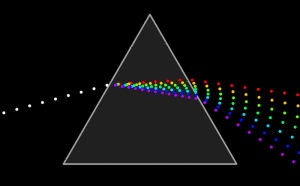 (C) Wikipedia, zum Animieren bitte klicken
Using a Prism dispersion leads to splitting of white light beam into individual colors. A rainbow where light takes different paths inside the water dropplets, depending on their wavelength is another “real world” example of dispersion.
Every optical medium / glass type has different refraction indices for the various wavelength of light. The number that describes how different the light paths of the various wavelengths are, is the Abbe-number.
UNder dispersion formulas you find the most common formulas
Each optical material (glasses, plastics, gases) have a different refraction index for each wavelength.
Instead of keeping long tables, it’s possible to describe the behaviour of optical materials by formulas.
here are the main formulas used :
1: Sellmeier (preferred)

2: Sellmeier-2

3: Polynomial

4: RefractiveIndex.info

5: Cauchy

6: Gases

7: Herzberger

8: Retro

9: Exotic

see
Optical Distortion
TV Distortion
Optical Distortion vs. TV Distortion
Barrel Distortion
Pincushion Distortion
(=EFL)
Distance between the principal point P2 and the focal point F2.
Don’t confuse with the back focal length (Back Focal Length BFL)!
