Archives
optical axis
Optical Density
Optical density is a measure used for filters to describe how much light of a blocked wavelength still passes the filter
Abbreviation: ODn
the optical density is given by the formula:
ODn = 10^-n = 1/10^n
ODn = 10^-n = 1/10^n
OD0 = 10^-0 = 1/10^0 = 1 = 100% light passes
OD1 = 10^-1 = 1/10^1 = 0.1 = 10% light passes
OD2 = 10^-2 = 1/10^2 = 0.01 = 1% light passes
OD3 = 10^-3 = 1/10^3 = 0.001 = 0.1% light passes
OD4 = 10^-4 = 1/10^4 = 0.0001 = 0.01% light passes
OD1 = 10^-1 = 1/10^1 = 0.1 = 10% light passes
OD2 = 10^-2 = 1/10^2 = 0.01 = 1% light passes
OD3 = 10^-3 = 1/10^3 = 0.001 = 0.1% light passes
OD4 = 10^-4 = 1/10^4 = 0.0001 = 0.01% light passes
The optical density is an input value, demanded by the Application.
OD2 equals 1 percent.
For a camera of 256 intensity levels this equals 2.6 intesity values. This is not much stronger than the sensor noise.
For a camera of 256 intensity levels this equals 2.6 intesity values. This is not much stronger than the sensor noise.
OD3 entspricht 0.1 Prozent.
For a camera of 256 intensity levels this equals 0.26 intesity values. This is less than the sensor noise.
The higher the number the better the blocking.
The higher the number the more expensive the filter.
The higher the number the more expensive the filter.
Typical values for comemrcial filters are OD2,
higher quality filters have OD3
Filters ilters for outdoor use might need OD4 or higher to block too intensive sunlight.
higher quality filters have OD3
Filters ilters for outdoor use might need OD4 or higher to block too intensive sunlight.
For a + b = c we get ODa + ODb = ODc
so you can generater an OD6 filter by two OD3 filters. However, the optics should be prepared for the thicker glass then.
so you can generater an OD6 filter by two OD3 filters. However, the optics should be prepared for the thicker glass then.
optical magnification

May the width of an object be 1.6mm and the sensor width = 4.8mm
Then

Then
May the width of an object be 36mm and the sensor width = 3.6mm
Then

Then
Optical Path Length
The optical path length is proportional to the time light needs to travel between two points


In a homogenous medium with refractuion index n and physical point distance d this formula simplifies to

In glass with the index of refraction of 1.5 for some wavelength for a physical point distance of d=10mm the optical path length

As glass has a different index of refraction for different wavelengths, the OPL is different for each wavelength
Some OPLs for glass type BK7 and a physical point distance of d=10mm
[table caption=”sample OPLs for BK7″ width=”400″ colwidth=”100|100|100|100″ colalign=”left|left|left”]
wavelength,index of refraction,phys. distance, OPL
400nm,1.5308,10mm,15.308mm,
500nm,1.5214,10mm,15.214mm,
600nm,1.5163,10mm,15.163mm,
850nm,1.5098,10mm,15.098mm,
940nm,1.5084,10mm,15.084mm
[/table]
In paraxial imaging system all of the light rays connecting a source point a to it’s image point have equal OLPs
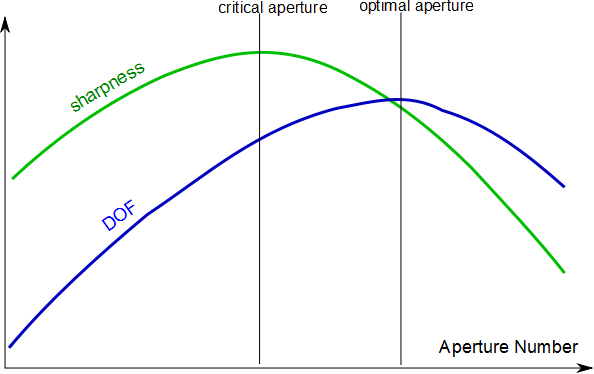
Optimal Aperture
orthographic
orthographic lenses are a type of fisheye lenses
orthographic lenses are also called” hemispherical“or “orthographisch”
orthographic lenses use an image mapping function of type

maintains planar illuminance
| Type : orthographic | weak | medium | strong | max |
|---|---|---|---|---|
| angles | 66° | 90° | 120° | < 180° |

An orthographic / hemispherical fisheye, uses a parallel projection of a hemisphere onto a plane. The resulting image will obviously be circular. The widest view angle is 180 degrees. At +/-90 degrees extreme distortion will occur. Due to this heavy distortion it’s less often used than f-Theta / angular fisheye.
see:
fisheye types
paraxial optics
is another term for Gaussian Optics
parfocal
A parfocal lens stays in focus when the magnification / focal length changes.
Some amount of defocussing is inevitable, but the amount is so small that it is considered as insignificant.
In microscopy parfocal lenses stay in focus when the magnification is changed.
The image stays focused when the magnification is changed from 40x to 10x
Most bright field microscoped are parfocal.
Motor-Zoom lenses are actually varifocal. When you change the magnification, also the focus changes. However the focus motor can work in parallel to the focal length motor, so for the user the lens seems to be parfocal.
pericentric
With pericentric lenses objects at larger distances appear larger(!) and objects at closer distances appear smaller.
Perizentric lenses allow for example to view a can from top and the sides at the same time.
This reverses our normal viewing experience.
Pericentric lenses got to be MUCH larger than the object under inspection.
see “comparison: entocentric – telecentric – pericentric”
Application : A cylinder with a drilling that is centered on one circular side and decentered on the opposite side is to be inspected for foreign parts in the drilling.
The rotation of the cylinder is not known, so we would need a lens that can look from all sides “outside-in” at the correct angle.
Solution: DIY with the help of a Fresnel Lens, a normal M12 lens and the graphic calculator below …
The rotation of the cylinder is not known, so we would need a lens that can look from all sides “outside-in” at the correct angle.
Solution: DIY with the help of a Fresnel Lens, a normal M12 lens and the graphic calculator below …