does (different from first order optics) include the effects of aberrations on the performance of an optical system.
The image quality is evaluated and the effects of diffraction sometimes included in the analysis.
Archives
TIR
total internal reflection
Total internal reflection (“TIR”) occurs, when the angle of incidence of a ray propagating from a higher indes medium to a lower index medium exceeds the critical angle.

[table caption=”Examples for critcal angles” width=”200″ colwidth=”100|100″ colalign=”left|left”]
 ,
,
1.3, 50.3°
1.4, 45.6°
1.5, 41.8°
1.6, 37.8°
1.7, 36.0°
1.8,33.7°
1.9, 31.8°
2.0, 30.0°
[/table]
for an interactive example, see refraction
Use of lenses under water
if you want to use lenses designed for the use “in air” in a housing under water, please do NOT use a plane window! The reasons get clear from the interactive graphics below.
If there is no other chance than to use a plane window, then place it close to the lens.
instead you should use a spherical window that shares it’s center with the entrance pupil (center of the appearant hole when looked from the front:
Vidicon tube
Before there were CCD and CMOS-sensors, there were Vidicon tubes.
Why to mention? These light receiving tubes influence till today the names for the sizes of our imaging sensors.
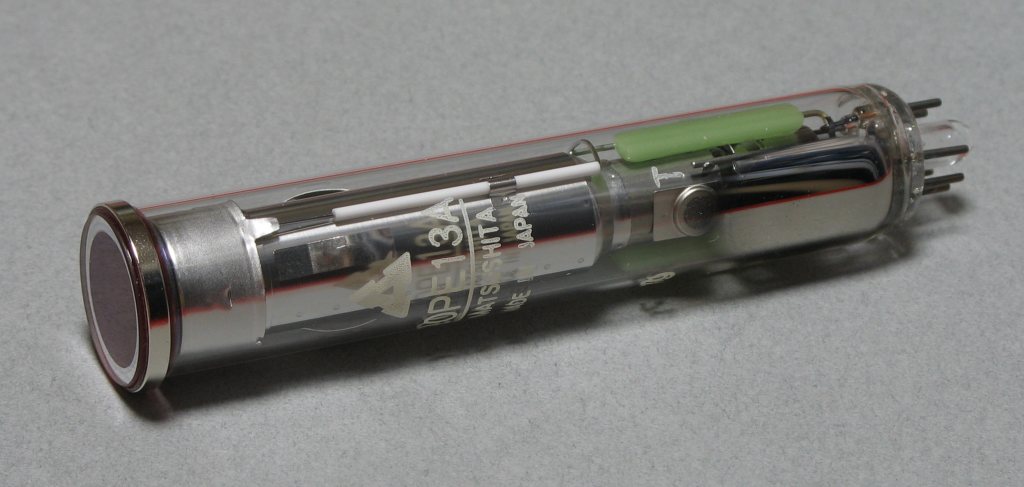
Vidicon tube (C) Wikipedia
The dark grey round area of the tube is the light sensitive part. Obviously the dark gray area can not reach the full diameter of the tube.
Lenses have a so called image circle, the round area on the image side of the lens that receives light. A lens has an image circle thats large enough to expose the dark gray part to light. if the dark area was 6mm in diameter, we talk of a 1/3″ lens, because the outer diameter of the Visicon tube is 1/3″ = 25.4/3mm = 8.467mm.
But has a 1″ lens an image circle which is 3x as large as a 1/3″ lens ?
A third inch lens has 6mm Image circle, so a one inch lens should have 3 times as much, say 18mm. It is 16mm only, however, because a vidicon tube with an 16mm diameter dark area had an outer diameter of one inch (25.4mm).
That’s why 1/3″ has 6mm and 1″ has 16mm image circle 🙂
Vignetting
Kinds of vignetting to distinguish:
vignetting, micro lens
A kind of vignetting which occurs exclusively with digital cameras.
In many sensors above the pixels so called microlenses are located, trying to capture and direct the light towards the light-sensitive parts of the sensor surface. This is but only up to certain angles with which the light passes to the sensor (eg 12 degrees off the vertical axis ). This can vary from sensor type to sensor type.
Micro lens vignetting can be avoided by a lens with a small angle of incidence (CRA Chief Ray Angle). Optimal is an image-side telecentric lens.
Note:
Some manufacturers try to avoid Micro lens vignetting by micro lenses that are shaped differently on the edge of the sensor than in the center.
To use such sensors with image side telecentric lenses, will result in (maybe unexpected) micro lens vignetting.
Some sensors have built an electronic correction of vignetting! (especially SOC (System on a Chip).
Using the software you can get rid of vignetting by so-called shading correction. However, this correction costs computing time and you may lose image dynamic by this correction.
vignetting, natural
to do
wavefront
surfaces (in mid air) of constant OPL (optical path length)
In a perfect optical system or a first order optical system all wavefronts are either planar or spherical.
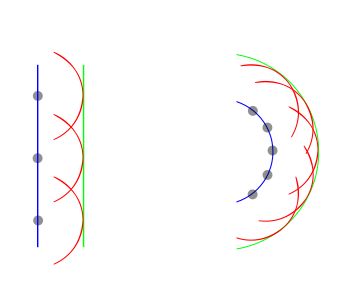
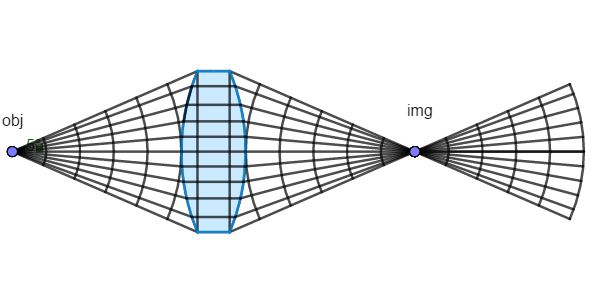
Wavefronts stay after reflection perpendicular to the propagation direction of the light.
wavenumber
number of wavelengths per cm
[table caption=”sample wavenumbers” width=”300″ colwidth=”100|100|100″ colalign=”left|left|left”]
wavenumber (cm^-1),wavelength (um),frequency (THz)
22727,0.440,682
18181,0.550,545
15152,0.660,455
11765,850,353
10000,1,300
1000,10,30
[/table]