for a circle of radius r is ‘1 rad’ the angle corresponding to length r on the circle,
say

accordingly :
 :
:

for a circle of radius r is ‘1 rad’ the angle corresponding to length r on the circle,
say
accordingly :
:
Lorem ipsum dolor sit amet, consectetur adipisicing elit, sed do eiusmod tempor incididunt ut labore et dolore magna aliqua. Ut enim ad minim veniam, quis nostrud exercitation ullamco laboris nisi ut aliquip ex ea commodo consequat.
The diameter of the smallest disk that a lens can produce as image of a point size object is called Airy-disk
According to the so called “Rayleigh Criterion” holds:

See F-number
A normal lens has pincushion distortion or barrel distortion which can be corrected to give a perfect perspective projection, like the image of a pin-hole camera.
This process is called “rectification” and is often applied for stitchich images, for example, in panoramic photography.
The resulting images has no distortion.

With  , roughly 300000km per second
 .
. [table]Medium,typical refractive index
Vacuum,1
Air,1.000293
Helium,1.000036
Hydrogen,1.000132
Carbon dioxide,1.00045
Water at 20 °C,1.333
Ethanol at 20 °C,1.36
Olive oil at 20 °C,1.47
Ice,1.31
PMMA (= acrylic = plexiglas),1.49
Window glass,1.52
Polycarbonate (Lexan™),1.58
Flint glass (typical),1.62
Sapphire,1.77
Cubic zirconia,2.15
Diamond,2.42
Moissanite,2.65, -[/table]
(= Short Mount) is a lens mount for use of mini-lenses with M12x0.5 thread (diameter = 12mm, 1 revolution = 0.5mm stroke.
S-mount lenses are either used in special holders, or with adapters or in C-mount CS-mount cameras.
Note:
Like with C-mount, CS-mount and F-mount lenses diameter and thread pitch are fixed.
But different from these the back flange length (distance from the mechanical stop of the lens to the sensor) is NOT standardized.
This can lead to mechanical problems with filters mounted between the lens and sensor.
The sagittal plane through a point is a plane perpendicular to the tangential plane trough the point, containing the point and the center of the entrance pupile.
Perpendicaular to it is the tangential plane.
Normally, the focus plane is 90 degree to the optical axis. This is due to symmetry reasons.
A problem arises when two objects have so different distances, that they can not be focussed at the same time.
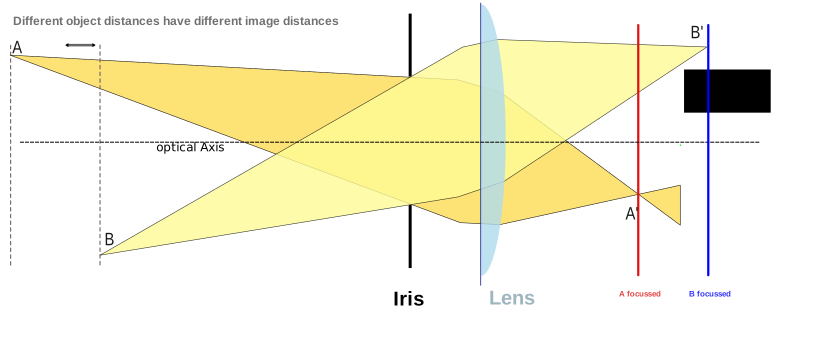
Theodor Scheimpflug had a genius idea : lets tilt the camera!
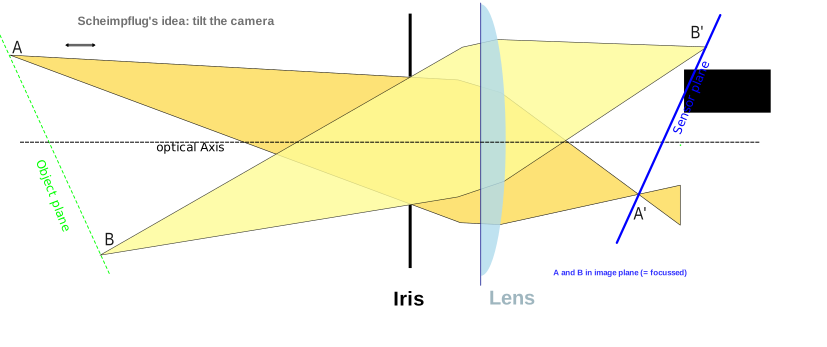
Then all point in the A-B-plane will be focussed!
Just tilting the camera of course is not enough, to get a focussed image. The Gaussian focus equation also must be satisfied.
The Gauss equation is however equivalent to the second Scheimpflug priciple.
Three planes must share a common line:
For a theoretical “thin lens” (=of virtual length 0) , it’s clear where this plane is. For the exact location in a real world lens, see below.
For a mind game lets keep the sensor plane and the object plane fixed and non-parallel. This defines a shared common line in 3D space. Through each line in Space there is an infinite number of Planes, containing it.
Obviously not all can be the plane of best focus.
Say:
In general the lens is tilted, but the image not focussed.
However, as soon as wwe use the lens focus mechanism, the first Scheimpflug principle is not satisfied any more, we would have to tilt the lens a little to satisfy the first criterion, but then the image is not focussed any more, etc.
The second (sufficient) condition can be the

But instead of the Gauss focus equation we can use the
These three planes must share a common line:
Usage: First place the object center (the green dot, the spot where the optical axis meets the object) at a local you like , for example at 60 on the x-axis.
Them move the lens (the other green dot) to a location where it’s possible to place the camera-lens position.
The interactive graphic keeps the optical axis in the center of the lens and maps the edges of the sensor to the wanted object plane.
The magnification if measured perpendicular(!) to the optical axis.
Keep in mind, that on your monitor you’ll see a trapezoid / trapezium)
